
Some of God’s greatest stories begin in the most forgettable places.
Several years ago, a small-town mail carrier was interviewed about his 40 years on the job. Every day he drove the same route—rain, snow, or summer heat. When asked how he stayed motivated, he said, “I figured if I showed up every day, somebody’s letter might carry a bit of good news.”
He wasn’t famous, wealthy, or powerful—but he was faithful. And in that faithfulness, he touched lives he never even met.
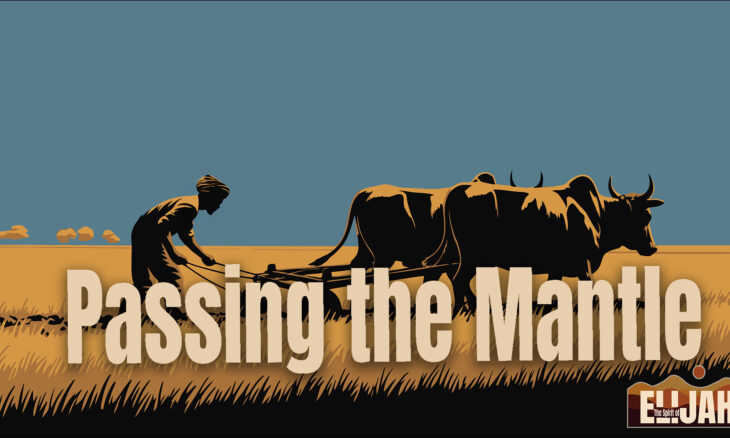
When Elijah found Elisha, there were no trumpets or fireworks—just a young man behind a team of oxen, doing what needed to be done. But that dusty field would become holy ground, because God was about to call an ordinary man to an extraordinary purpose.
- We’re quick to believe that God calls missionaries, preachers, or prophets—but what if He’s calling you right where you are?
- What if your routine—the plow in your hands, the field beneath your feet—is the very place He plans to start something new?
That’s the story of Elisha.
A story that reminds us:
- God meets us in the middle of the ordinary,
- God’s call interrupts and invites,
- Faithful obedience often requires letting go,
- And God works powerfully through the handing of mantles—from one generation to the next.
I Kings 19:19
So he departed from there and found Elisha the son of Shaphat, who was plowing with twelve yoke of oxen in front of him, and he was with the twelfth. Elijah passed by him and cast his cloak upon him.
I. God Meets Us in the Middle of the Ordinary
A. Elisha was doing what he knew to do.
When God’s call found Elisha, he wasn’t standing at a crossroads waiting for a mystical experience or a flashing sign from heaven. He was out in the field — hands blistered, clothes dusty, pushing a plow behind a team of oxen. He was faithfully tending to the everyday responsibilities of life.
So often, we imagine God’s call as something that happens on a mountaintop or in a moment of spectacular revelation. But Scripture paints a different picture — God tends to call people while they’re already being faithful with what’s in front of them.
- Moses was tending sheep in the wilderness when a burning bush interrupted his routine (Exodus 3).
- David was out with his father’s flock when the prophet Samuel came looking for Israel’s next king (1 Samuel 16).
- Peter and Andrew were mending nets when Jesus said, “Follow Me, and I will make you fishers of men” (Matthew 4:18–20).
God delights in calling people who are already working, already trusting, already showing up — even when no one’s watching. Ordinary faithfulness becomes the soil in which extraordinary callings take root.
Sometimes we miss the most the hero’s among us captivated by the celebrities that demand that we give them attention!
- Think about a small-town mechanic who opens his shop every morning before sunrise.
- He’s worked on the same trucks for years — same customers, same routine, same tools hanging on the pegboard.
- It may look mundane to others, but he takes pride in his work because it matters to someone
- A farmer getting to the field,
- A mom driving her kids to school,
- A neighbor needing to get to the doctor.
- Picture a teacher, long after the bell rings, sitting at her desk grading papers under the hum of fluorescent lights.
- Nobody applauds her diligence, but her faithfulness in that unseen space shapes lives.
That’s where God often meets us — not when we’re trying to climb higher, but when we’re quietly plowing the field He’s already placed us in.
B: Don’t wait for your life to feel “sorted out” before obeying God.
Don’t assume that calling only comes after you’ve cleaned up your past, landed the right job, or figured out all your questions.
- God’s voice often breaks through while we’re doing what’s ordinary — parenting kids, clocking in at work, running errands, serving quietly in church.
If we’re faithful in the field, He can redirect our steps toward a new purpose in His timing.
- Are you plowing your field faithfully today?
- Are you treating your current responsibilities as a place God can use you?
Because calling doesn’t wait for perfection — it begins in motion.
Colossians 3:23
“Whatever you do, work heartily, as for the Lord and not for men.”
Zechariah 4:10 – “Do not despise these small beginnings, for the Lord rejoices to see the work begin.”
Luke 16:10 – “One who is faithful in a very little is also faithful in much.”
1 Kings 19:19-20
And he left the oxen and ran after Elijah and said, “Let me kiss my father and my mother, and then I will follow you.” And he said to him, “Go back again, for what have I done to you?”
II. God’s Call Interrupts and Invites (vv. 19–20)
“Then he left the oxen and ran after Elijah…”
A. God’s call is personal and disruptive.
When Elijah cast his cloak across Elisha’s shoulders, there were no fireworks, no booming voice from heaven, no thunder rolling across the fields. Just a silent act — a weathered prophet’s mantle falling across a young man’s back. But that simple gesture carried divine weight. It was God’s way of saying, “You are chosen. You’re next.”
God often works like that — quietly but unmistakably.
- His call interrupts our rhythm not with noise, but with meaning.
- It’s that inner stirring that won’t go away.
- The sense that God is redirecting your path, even when you hadn’t planned on moving.
Elisha’s ordinary day turned sacred in an instant. The plow lines in the soil became the line between what was and what would be.
Or picture a young man sitting in church when the preacher’s words seem to land right on his heart. Nobody else notices, but he feels it — that tug that says, “This is for you.” That’s often how God calls — not through spectacle, but through a quiet interruption that rearranges priorities.
Consider the Jesus Call of some of the apostles.
Matthew 4:19–20
“Follow Me, and I will make you fishers of men. Immediately they left their nets and followed Him.”
Elijah’s cloak said, “God sees you.” And once you’ve been seen by God, life can never stay the same.
B. Elisha’s Response Was Immediate but Thoughtful
Elisha didn’t hesitate to act — he ran after Elijah.
- Yet he wasn’t careless or impulsive.
His request to kiss his parents goodbye wasn’t rebellion or delay; it was respect. He understood that following God’s call meant leaving something behind, and he wanted to do so with honor.
Following God means saying “yes” to His future, even if it means loosening your grip on your past.
What might you be holding onto that’s keeping you from following fully?
- Maybe it’s the comfort of security — a job, income, or reputation that feels too good to risk.
- Maybe it’s a toxic habit — something you know isn’t life-giving but you’ve learned to live with it.
- Maybe it’s fear — the voice that whispers, “You’re not ready,” or “You might fail.”
God’s call always carries both a cost and a promise. It disrupts what’s comfortable, but it invites us into something greater.
Elisha had no guarantee of success, no job description, no salary, no security — just a call and a cloak. Yet he ran after it, because he trusted the One who called.
When God places a mantle on your life, don’t overthink it. Don’t wait for conditions to improve. Run after Him — and watch how obedience opens doors you never imagined.
Luke 9:62 – “No one who puts his hand to the plow and looks back is fit for the kingdom of God.”
1 Kings 19:21
And he returned from following him and took the yoke of oxen and sacrificed them and boiled their flesh with the yokes of the oxen and gave it to the people, and they ate. Then he arose and went after Elijah and assisted him.
III. Faithful Obedience Requires Letting Go
“He took his yoke of oxen and slaughtered them… and followed Elijah.”
A. Elisha made a clean break from his old life.
When Elisha decided to follow Elijah, he didn’t just walk away — he burned the plow. Literally.
- He slaughtered his oxen, chopped up his equipment, built a fire, and hosted a farewell feast. It was his way of saying, “There’s no going back.”
That’s what commitment looks like. No safety net. No “just in case this doesn’t work out.”
- He burned the symbols of his old livelihood — the very tools that had defined his identity — because he believed God’s new direction was worth it.
The Apostle Paul echoed this same spirit centuries later:
Philippians 3:13–14 – “Forgetting what is behind and straining toward what is ahead, I press on toward the goal to win the prize for which God has called me heavenward in Christ Jesus.”
When God calls us forward, He also calls us to release what was — not because it was bad, but because it’s no longer the place He’s calling us to stay.
History gives us a vivid picture of this kind of all-in faith.
In 1519, Spanish explorer Hernán Cortés landed on the shores of Mexico with about 600 men, determined to explore and conquer new territory. When they arrived, he did something shocking: he ordered the ships to be burned. There would be no retreat, no way back. The only option was forward.
- In a sense, Elisha did the same thing — he burned the ships of his old life.
- He wasn’t going to “keep the plow in the barn” just in case the prophet’s life didn’t work out.
- He chose full devotion over fallback.
Every disciple of Jesus eventually faces that same decision: Will I keep a backup plan for my obedience, or will I go all in?
B. Faithfulness Means Release Before Reward
Elisha’s faithfulness didn’t start when the miracles began — it started in the moment he let go. Before he ever saw God’s power, he surrendered his plan.
You can’t take hold of a new calling if your hands are still gripping the old one.
- Abraham couldn’t cling to Ur and still walk toward Canaan.
- Peter couldn’t keep his nets and still follow Jesus.
- And Elisha couldn’t keep his plow and still walk behind Elijah.
God’s blessings often come after surrender, not before it. The reward follows the release.
What “plow” might God be asking you to burn?
- Maybe it’s a habit that feels safe but holds you back from spiritual growth.
- Maybe it’s a comfort zone — a routine or lifestyle that keeps you from stepping into faith-stretching obedience.
- Maybe it’s even a past success that you keep polishing instead of pursuing what’s next.
Sometimes God asks us to lay down something good so He can give us something better.
- When you surrender what’s familiar, you make room for what’s eternal.
- When you give up control, you discover calling. When you burn the plow, you make space for fire from heaven.
Matthew 16:24–25 – “Whoever wants to be my disciple must deny themselves and take up their cross and follow Me.”
I Kings 19:21
Then he arose and went after Elijah and assisted him.
IV. God Works Powerfully in Transitions
A. God’s Kingdom moves through the handing of mantles.
The story of Elijah and Elisha isn’t just about one man’s calling — it’s about the way God’s kingdom continues from one generation to the next. The passing of the mantle wasn’t a mere transfer of clothing; it was a transfer of mission, power, and purpose.
When Elijah threw his cloak across Elisha’s shoulders, he was saying, “What God has started through me, He intends to continue through you.”
B. God’s Kingdom Moves Through generations.
Elijah’s act wasn’t an ending — it was a continuation.
- God’s work didn’t stop when Elijah’s time was done, because God’s story never hinges on one person.
- It flows through obedient hearts generation after generation.
From Abraham to Isaac, from Moses to Joshua, from Paul to Timothy — the pattern is the same: God raises up one, then calls another to carry the mission forward.
Elijah had called down fire from heaven, confronted kings, and defended God’s honor in dark times. Yet his legacy would not be measured only by what he accomplished, but by who he prepared to carry it on.
That’s how the kingdom moves — not by celebrities or superstars, but by faithful people handing off the mantle of faith, leadership, and courage.
C. Every Believer Carries a Mantle
This isn’t just a story for prophets — it’s a pattern for every believer. Each of us carries a mantle: a calling, a responsibility, a piece of God’s ongoing work in the world.
Parents carry a mantle of faith to pass to their children.
“You shall love the Lord your God with all your heart… and you shall teach them diligently to your children.” — Deuteronomy 6:5–7
Mentors and disciplers carry a mantle to invest in others.
“What you have heard from me… entrust to faithful people who will be able to teach others also.” — 2 Timothy 2:2
Church leaders and servants carry a mantle of stewardship — to lead faithfully and to raise up those who will lead after them.
The kingdom of God advances not by one generation’s strength, but by their willingness to pass the faith forward.
In a relay race the fastest team doesn’t always win — the team with the best handoff does. The baton must be passed while both runners are in motion. The exchange zone is brief — just a few strides — but it determines the outcome of the entire race.
If the runner holding the baton hesitates, drops it, or fails to pass it cleanly, the team loses momentum — or even disqualifies.
That’s what the mantle moment represents. The faith of one generation is meant to be passed while both are running. The older must not stop before passing it, and the younger must be ready to receive it.
You’re either preparing to receive a mantle or to pass one.
No one stands still in God’s relay — everyone has a role.
- If you’re in a season of receiving: Who are you learning from? Who’s speaking truth, wisdom, and encouragement into your walk with God?
- If you’re in a season of passing: Who are you investing in? Who’s watching your obedience and being shaped by it — your children, a young believer, someone struggling in faith?
The call of the Kingdom is never just to run your race, but to ensure the next runner can run theirs.
When your life is over, will someone be carrying the mantle you once wore — faith stronger because of your example, courage deeper because of your obedience, hope brighter because of your influence?
God’s story continues through ordinary people who say, “Lord, let Your mantle fall here — and let me pass it on well.”
Conclusion:
When Elijah’s cloak fell across Elisha’s shoulders, a story that began in a plowed field would ripple across generations.
- Elisha left everything to follow God’s call.
- He burned his plow, said goodbye to comfort, and stepped into the unknown.
- But that act of obedience didn’t just change his life—it set in motion a pattern that still carries on today.
God still calls ordinary people to do extraordinary things.
- He still interrupts our routines, asking us to trust Him in the in-between.
- He still uses everyday faithfulness as the seedbed for eternal fruit.
Maybe today, God is tugging at your heart like Elijah’s cloak on Elisha’s shoulders.
- Maybe He’s whispering, “It’s time to move forward.”
- Maybe He’s asking you to lay something down so He can raise something new.
Or maybe you’ve been running your race for a while—and it’s time to hand the baton to someone else.
- There’s a young believer, a child, a friend watching how you run.
- Your faith could be the mantle they wear next.
Faith doesn’t wait for perfect conditions. It just says yes.
And when we say yes—when we burn the plow, follow the call, and pass the mantle—God’s kingdom moves forward again.
So today, in whatever field you find yourself, may you hear God’s voice calling your name.
May you be faithful where you are, obedient when He calls, surrendered when He asks, and generous when it’s time to pass it on.
Because the story isn’t over—and God is still writing it through you.